
How to Prepare Chemistry for JEE Main: Chemistry Coaching in Kanpur
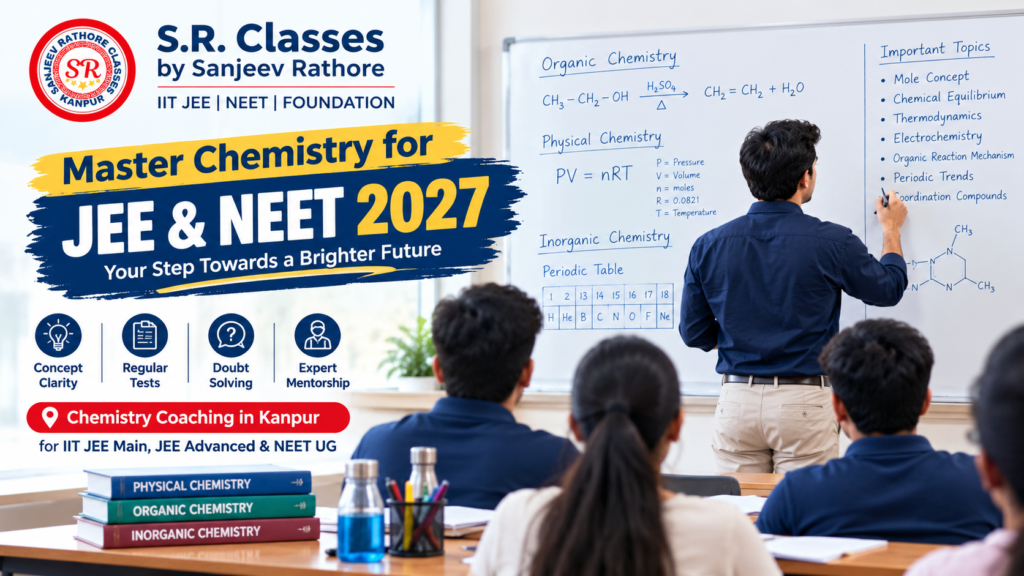
Best Chemistry Coaching in Kanpur 2027: Preparing for competitive examinations like JEE Main, JEE Advanced, and NEET requires a strong understanding of scientific concepts, regular practice, and a well-planned study strategy. Among the major subjects, Chemistry can become a scoring subject when students focus on conceptual clarity, systematic revision, and consistent question-solving practice. For students searching for Chemistry Coaching in Kanpur, choosing the right academic guidance can help make preparation more organised and effective. At S.R. Classes by Sanjeev Rathore, students preparing for IIT JEE, NEET UG, and Foundation courses can explore a structured learning environment focused on concept development, practice, and doubt resolution. In this guide, we will discuss how to prepare Chemistry for JEE Main, JEE Advanced, and NEET 2027, identify important study habits, and understand how the right preparation strategy can improve performance. Why Is Chemistry Important for JEE and NEET? Chemistry is an essential subject in both engineering and medical entrance examinations. However, students often make the mistake of treating it as a subject that requires only memorisation. In reality, Chemistry involves conceptual understanding, logical reasoning, numerical problem-solving, and the ability to apply scientific principles to different questions. For JEE aspirants, Chemistry can help build a balanced preparation strategy alongside Physics and Mathematics. For NEET aspirants, it forms an important part of the examination alongside Physics and Biology. A strong Chemistry preparation plan should focus on three major areas: Students should develop a separate preparation strategy for each branch instead of relying on the same study method for every chapter. 1. Build a Strong Foundation in Chemistry The first step towards effective preparation is understanding the fundamentals. Students who develop strong basics often find it easier to understand advanced topics and solve unfamiliar questions. Start by studying the prescribed syllabus and dividing it into manageable chapters. Before moving to complex problems, ensure that you understand the definitions, principles, formulas, reactions, and examples associated with each topic. For instance, chapters such as Some Basic Concepts of Chemistry, Atomic Structure, Chemical Bonding, and the fundamentals of Organic Chemistry help establish knowledge that is useful across multiple topics. Students in Classes 9 and 10 can also benefit from developing an early foundation in science and mathematics before beginning dedicated JEE or NEET preparation. 2. Follow a Different Strategy for Each Branch of Chemistry Physical Chemistry: Focus on Concepts and Numerical Practice Physical Chemistry requires a combination of theoretical understanding and calculation skills. Students should understand the derivation or application of important formulas rather than memorising them without context. Follow these steps: Topics such as Mole Concept, Chemical Equilibrium, Thermodynamics, and Electrochemistry deserve systematic practice according to the applicable examination syllabus. For JEE Advanced, students should gradually work on multi-concept problems that require deeper reasoning. NEET aspirants should also practise calculations while maintaining a strong understanding of the prescribed syllabus. Organic Chemistry: Understand Reaction Mechanisms Organic Chemistry can become difficult when students try to memorise every reaction separately without understanding the underlying principles. Begin with fundamental concepts such as electronic effects, reaction intermediates, acidity and basicity, and the behaviour of functional groups. After developing these fundamentals, study individual reactions and understand why they occur. Create concise reaction maps and revision notes to connect related concepts. Useful preparation habits include: A conceptual approach can make Organic Chemistry more manageable and improve the ability to solve unfamiliar problems. Inorganic Chemistry: Combine Understanding With Revision Inorganic Chemistry requires consistent revision because students must remember chemical properties, trends, structures, reactions, and other factual details. For NEET preparation, NCERT Chemistry textbooks are particularly important. JEE aspirants should also use the prescribed syllabus, relevant textbook concepts, and suitable practice material. To improve retention, students should: Instead of waiting until the entire syllabus is completed, revise previously studied chapters every week. 3. Create a Practical Study Timetable for JEE and NEET 2027 A timetable helps students distribute their time between learning new concepts, practising questions, and revising earlier chapters. However, an effective timetable should be realistic. A schedule that is too demanding can become difficult to maintain alongside school studies and other subjects. A sample daily Chemistry routine could include: These timings are illustrative and should be adjusted according to the student’s class schedule, preparation level, and examination requirements. Students preparing for JEE Main and JEE Advanced should balance Chemistry with Physics and Mathematics. NEET aspirants should allocate sufficient time to Physics and Biology as well. Consistency is more useful than following an unrealistic timetable for only a few days. 4. Practise Previous-Year Questions and Mock Tests Reading theory is only one part of competitive examination preparation. Students must also learn how to apply concepts under examination conditions. Previous-year questions help students become familiar with question formats, recurring concepts, and the level of application expected in different examinations. Chapter-wise practice should begin after completing the relevant concepts. Once sufficient chapters have been covered, students can introduce mixed-topic tests and full-length mock examinations. After every test, review the following: Do not focus only on the final score. Test analysis helps students understand what needs to change in their preparation. 5. Use NCERT, Study Material, and Revision Notes Effectively Using too many books and online resources can create confusion. Students should select reliable resources that match the prescribed syllabus and their examination goals. For NEET aspirants, careful study of NCERT Chemistry is essential. For JEE Main and JEE Advanced, students should combine relevant textbook learning with appropriate problem-solving practice and previous-year questions. Maintain a separate notebook containing: These notes become particularly useful during revision, when students need to revisit important concepts without reading every chapter from the beginning. Always verify the syllabus and examination requirements for the relevant year before finalising your study resources. 6. Identify Weak Areas and Work on Them Early Many students repeatedly practise topics they already understand while avoiding difficult chapters. Although this may provide temporary confidence, it can leave important gaps in preparation. A better strategy is to identify weak topics through chapter tests, assignments, and mock examinations. For example, if you repeatedly